
Written by Michael Rizk, Co-Founder & Senior Physiotherapist
TL;DR: A physio can confirm how badly the calf muscle is strained, rule out look-alikes like a blood clot, and guide your rehab. Most calf strains take roughly 2 to 12 weeks to recover, depending on severity. Start gentle movement early, avoid heat and massage for the first few days, and get it assessed.
- Physio grades the strain, rules out more serious causes and builds your rehab.
- Recovery runs from about 2 weeks for mild strains to 12 weeks for severe ones.
- Rest the calf for the first few days, keep it moving gently, and book an assessment.
If you felt a sudden pull or “snap” in your calf, a physio assessment is the best first step to find out how bad it is and how to recover properly.
A calf strain is a tear in the muscle fibres at the back of your lower leg, usually the gastrocnemius or soleus. Treatment starts with a few days of relative rest, then gradual loading with your physio’s guidance.
What Does a Calf Strain Feel Like?
Most people describe a sudden sharp pain, as if something hit the back of their leg. Some hear or feel a pop but pain may not hit straight away. It can feel fine for a few steps and then the calf tightens up. Swelling, bruising and tenderness in the calf follow, and walking on tiptoe or pushing off becomes painful.
A StatPearls clinical review of gastrocnemius strain grades these injuries from 1 to 3. Grade 1 is mild with minimal loss of strength, grade 2 means you often can’t walk normally at the time of injury, and grade 3 is a severe tear that can leave a palpable gap in the muscle.
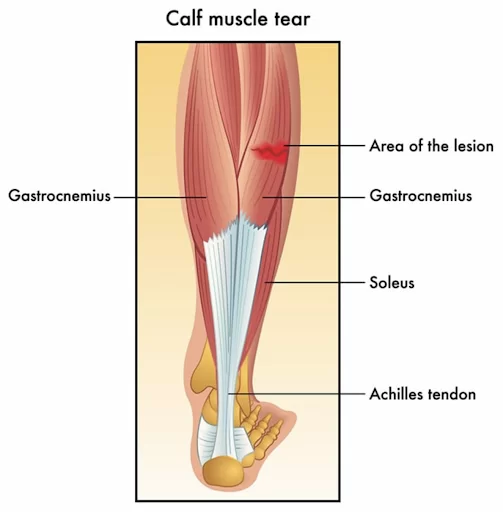
How Does a Calf Strain Happen?
It usually happens when the calf is stretched and loaded at the same time, for example pushing off with a straight knee while the ankle is bent upward, a sudden change in direction, or a sudden accelleration.
That is why it shows up in tennis, netball, basketball, football and fun runs, as well as a sprint for the bus.
Fatigue, poor warm-up and a sudden jump in activity all make it more likely. It occurs in middle-aged and older adults as well as athletes, which is why the injury is sometimes called “tennis leg”.
Is It a Calf Strain or Something More Serious?
Calf pain can also come from a blood clot (deep vein thrombosis), an Achilles tendon issue or, more rarely, compartment syndrome.
The same StatPearls review notes that in one study of 141 people with a clinical diagnosis of calf strains, a small percentage turned out to have a more serious condition instead. However, in most cases it is just a plain old calf strain.
Seek urgent medical care if your calf is hot, red, swollen all the way down the leg, or you also have chest pain or shortness of breath. Do the same if you can’t push off your foot at all, as that can point to something more serious like an Achilles rupture.
A physio can run the clinical tests to tell these apart and refer you on for ultrasound or MRI if needed.
What Should You Do in the First Few Days?
Rest the calf, apply ice, use a compression bandage and elevate the leg. Heat and massage are best avoided early, because they can increase bleeding in the muscle.
A 2025 narrative review in Sports Medicine suggests rest for roughly the first 3 to 5 days, with gentle movement and light isometric work starting as pain allows. It also advises against non-selective anti-inflammatories for the first 24 to 72 hours because of bleeding risk, so check with your GP or pharmacist about pain relief.
Keep walking as comfortably as you can. Early gentle movement helps prevent the muscle healing tight and stiff.
How Long Does a Calf Strain Take to Heal?
The same 2025 review puts mild to moderate calf strains at roughly 2 to 6 weeks of rehab, and severe strains at roughly 6 to 12 weeks.
In a study of 149 calf strains in elite Australian footballers, players with severe aponeurosis damage on MRI took an average of 31 days to return, compared with 19 days without it (Green et al., 2020, American Journal of Sports Medicine).
This study was focussed on elite athletes with daily physio, so for us normal people we need to allow longer when returning to work on your feet or just recreational weekend sport.
Returning too early is the main risk in most cases. That is the point when you are mostly pain free, but the injury is not fully healed yet. The 2025 review found re-injury risk is highest in the first two months after a calf strain.
How Physio Helps With a Calf Strain
A physio grades the injury, checks for red flags and works out how much load your calf can handle right now.
Rehab moves from gentle stretching and isometric holds to calf raises, then to walking and sport-specific work as strength returns. You return to full activity when the calf is no longer tender to touch, has regained its strength, and when you pass the return to sport/activity benchmarks .
If you play sport or run, our sports injury physio and running physio services cover the return to play, and our rehabilitation service helps if you are heading back to a busy week on your feet.
When To See a Physio
Whether the pain is mild or you can barely walk, a physio assessment tells you what is going on, how to move safely in the meantime and how to stop it happening again.
Book in early if you can’t walk normally, the swelling or bruising is significant, or the pain isn’t improving after a few days. We see calf strains at Rozelle, Panania, Clovelly and Waverley.
Key Takeaways
- Book a physio now. We can grade the strain, rule out look-alikes and plan your recovery.
- A calf strain is a tear in the calf muscle fibres, usually from a sudden push-off or stretch under load.
- Calf pain with a hot, red, swollen leg needs urgent medical care to rule out a blood clot.
- Avoid heat and massage early, and keep moving gently as pain allows.
- Recovery runs from roughly 2 weeks for mild strains to 12 weeks for severe ones.
- Reinjury risk is highest in the first two months, so return to full activity gradually.
If a calf strain is holding you back, our physiotherapists can assess it and build a plan around your goals. Book an appointment online at your nearest iMove Physiotherapy clinic.
FAQ
Should I stretch a strained calf?
Not hard in the first few days. Gentle movement is helpful, but aggressive stretching can aggravate the tear. Your physio will tell you when to add stretching.
Can I walk on a strained calf?
Yes, as pain allows. Early gentle walking helps prevent stiffness. If you can’t walk without a limp or the pain is severe, get it assessed promptly.
How do I know if it’s a blood clot and not a calf strain?
You can’t tell reliably at home. A hot, red, swollen leg, or pain with chest tightness or breathlessness, needs urgent medical attention. Your physio can screen for red flags and refer you on.
Should I massage my calf?
Not early on. Massage and heat can increase bleeding in the first few days. Your physio will advise when hands-on treatment is appropriate.
Do I need an ultrasound or MRI?
Not always. Many calf strains are diagnosed from your history and examination. Imaging is used if the injury is severe, isn’t improving or the diagnosis is unclear.
Will my calf strain come back?
It can, especially if you return too early or have had one before. A graded return, calf strengthening and checking your strength before sport lower the risk.
iMove Physiotherapy clinics: Rozelle | Panania | Clovelly | Waverley
